Blog · October 13, 2026 · Rich Chetwynd
Meta Muse Wonder for vibe coding (and where to host the app)
Meta announced Muse Wonder with strong reported scores on long-horizon coding and agent workflows. Claude Opus 5.5 still leads some coding benches. After you build with any model, Croft is where your team runs the app.
Quick answer
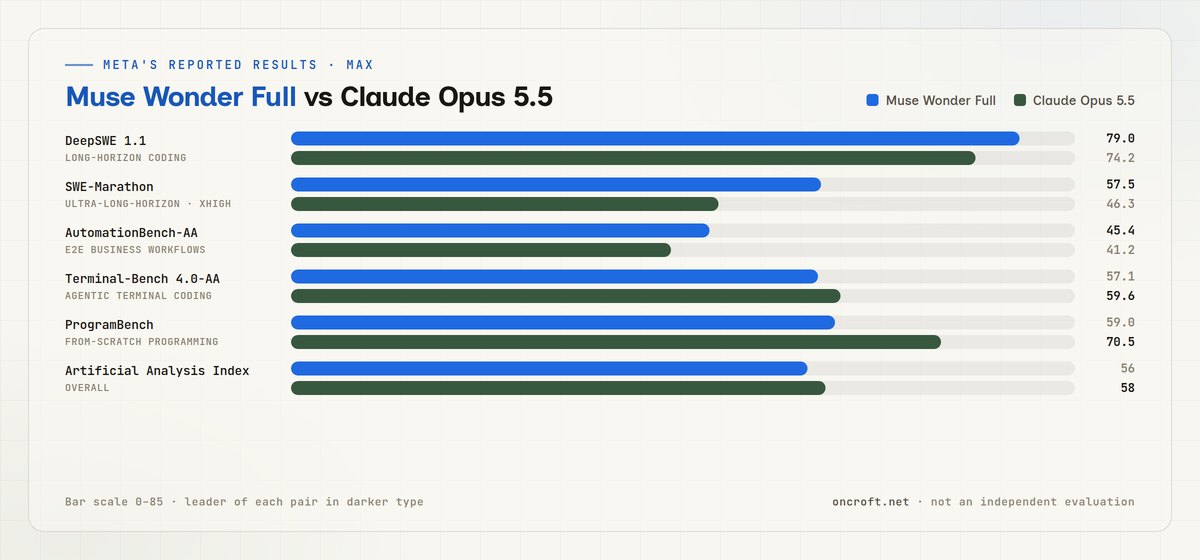
Meta announced Muse Wonder today: two models, Muse Wonder and Muse Wonder Full, aimed at personal and professional agents. On Meta’s reported table (max settings), Muse Wonder Full leads several long-horizon coding and agent-workflow benches — DeepSWE 1.1 at 79.0, SWE-Marathon at 57.5 (xhigh), AutomationBench-AA at 45.4. Claude Opus 5.5 still leads Terminal-Bench 4.0-AA (59.6), ProgramBench (70.5), and the overall Artificial Analysis Index (58).
Those figures are Meta’s reported results, not an independent league table. For teams and developers vibe coding an app, the practical split is: pick the model that fits the job; then put the app somewhere private the team can actually run.
What Meta announced
From Meta’s Muse Wonder research post:
- Two models: Muse Wonder and Muse Wonder Full
- Active Memory (carry relevant context across conversations) and Active Focus (keep working a hard goal, try other approaches, check in before important actions)
- Domain work Meta highlights: law, finance, and health, plus frontier coding
- Muse Wonder is available today through the Meta Model API and Muse Code
- Muse Wonder Full is available today for Muse Code subscribers
- Meta says Muse Wonder will soon power experiences in Muse, rolling out first to subscribers, and will power artifact generation
Meta did not publish pricing, a general consumer rollout date, or a Vibe Code Bench score in that post.
What Meta’s numbers mean for vibe coding
Vibe coding is describing an app and steering until it works. Long-horizon coding benches are a useful proxy for that: the model has to keep requirements in mind, change a codebase, test, and recover. Agent and workflow benches matter if the app has to do a job, not just render a screen.
On Meta’s comparison table (Muse Wonder Full max, Muse Wonder max, Claude Fable 5.1 max, GPT-6 Astra max, Claude Opus 5.5 max):
Where Meta reports Muse Wonder Full ahead
- DeepSWE 1.1 (long-horizon coding): 79.0 vs Opus 5.5 at 74.2, Astra at 74.1, Fable 5.1 at 67.4. Muse Wonder (the smaller of the two) is 78.8.
- SWE-Marathon (ultra-long-horizon engineering): 57.5 (xhigh) vs Opus 5.5 at 46.3. Muse Wonder is 53.1.
- AutomationBench-AA (end-to-end business workflows): 45.4 vs Astra 41.6 and Opus 5.5 at 41.2.
- Harvey LAB-AA (legal agent work): 13.1 vs Opus 5.5 at 4.2.
- MemoryBench (remembering context): Muse Wonder 85.6, Muse Wonder Full 85.5, vs Opus 5.5 at 81.5.
Where Meta’s table still has Claude Opus 5.5 ahead
- Terminal-Bench 4.0-AA (agentic terminal coding): 59.6 vs Muse Wonder Full at 57.1. GPT-6 Astra is 59.1.
- ProgramBench (from-scratch programming): 70.5 vs Muse Wonder Full at 59.0 — a wide gap on this bench.
- Artificial Analysis Index (overall): 58 vs Muse Wonder Full at 56.
- HealthBench Pro: 65.6 (Astra 65.3) vs Muse Wonder Full at 62.3.
- OSWorld V2.1 (partial): 81.8 vs Muse Wonder Full at 78.4.
A compact slice of the coding and overall scores Meta reported:
| Benchmark | Muse Wonder Full | Claude Opus 5.5 | Lead on Meta’s table |
|---|---|---|---|
| DeepSWE 1.1 | 79.0 | 74.2 | Muse Wonder Full |
| SWE-Marathon | 57.5 | 46.3 | Muse Wonder Full |
| AutomationBench-AA | 45.4 | 41.2 | Muse Wonder Full |
| Terminal-Bench 4.0-AA | 57.1 | 59.6 | Claude Opus 5.5 |
| ProgramBench | 59.0 | 70.5 | Claude Opus 5.5 |
| Artificial Analysis Index | 56 | 58 | Claude Opus 5.5 |
Honest read for a team building apps with AI: Muse Wonder looks strong when the work runs long — multi-step coding, business workflows, keeping context. Opus 5.5 still wins some of the coding suites that look more like from-scratch programs and terminal agents, and it leads Meta’s overall index. GPT-6 Astra and Claude Fable 5.1 sit in the mix on the same table.
Treat this as Meta’s snapshot on launch day. Public app-building leaderboards (see best models for vibe coding) measure something different, and they move.
After you build, you still need a host
Whichever model writes the app — Muse Wonder, Claude, GPT, Cursor, Grok — a chat preview is not a place your team can work. You still need:
- A private server that stays up
- Company login, so only your people get in
- A database everyone shares
- Schedules for jobs that should run without someone clicking
- Monitoring, so a bad deploy is visible
- Backups and rollback when a prompt breaks something
That is hosting. It is also where most vibe-coded prototypes die.
Croft is the place the team runs it
Croft does not sell models and does not pick a vendor. Croft is an MCP server, so it works with any MCP-capable assistant. Meta’s post does not describe a Muse-specific Croft integration; use the client you already have.
The loop is the same:
- Describe the app in your assistant (or in Ask Croft in the browser).
- Deploy to your croft.
- Invite the team. They sign in once.
You get a live URL on your own private server, behind one company login, with a database, schedules, and monitoring included. Connect setup: Claude, ChatGPT, Cursor, Grok, or any MCP client.
Related
- Best models for vibe coding — public benches, assistants, and how to choose
- Vibe coding hosting — where the app lives after the chat window
- AI app hosting — private hosting for apps you build with AI
- Connect your AI assistant — MCP setup
- Google Gemini 4 Argon for vibe coding — the last frontier-model drop, same hosting gap
FAQ
What is Muse Wonder?
Meta’s new frontier series, launched 13 October 2026 (NZ): Muse Wonder and Muse Wonder Full. Meta says they target personal and professional agent work, with Active Memory and Active Focus. Availability in Meta’s post: Meta Model API and Muse Code today; Full for Muse Code subscribers; Muse product rollout coming, subscribers first.
Is Muse Wonder the best model for vibe coding?
On Meta’s table it is the one to watch for long-horizon coding and agent/business workflows. Opus 5.5 still leads Terminal-Bench, ProgramBench, and the Artificial Analysis Index. Use the model that matches the job; rankings will move.
Can I connect Muse Wonder to Croft?
Croft works with any MCP-capable assistant. Meta did not publish a Croft (or MCP) setup in the announcement. Point your MCP client at Croft, build, deploy.
Where should a team host an app built with Muse Wonder?
On a private host with company login and a database. That is Croft. Public preview URLs are for demos, not internal tools.
How much does Croft cost?
Solo from $24/month on annual billing, Team $99/month on annual. 7-day free trial, no card to start. Pricing →
Where to learn more
- Meta research post: Muse Wonder
- Croft: Get your croft — 7-day free trial, Solo from $24/mo annual
Stake out your croft.
Your team's first app could be live before lunch.
Start free trial7 days free, no card to start. From $24/month - cancel anytime and take everything with you.