Blog · October 12, 2026 · Rich Chetwynd
How to share an onboarding checklist app with your team
Host an onboarding checklist built with AI as a private team app on Croft. One URL, shared new-hire progress, company login, backups. Not emailed HTML or a public host.
Quick answer
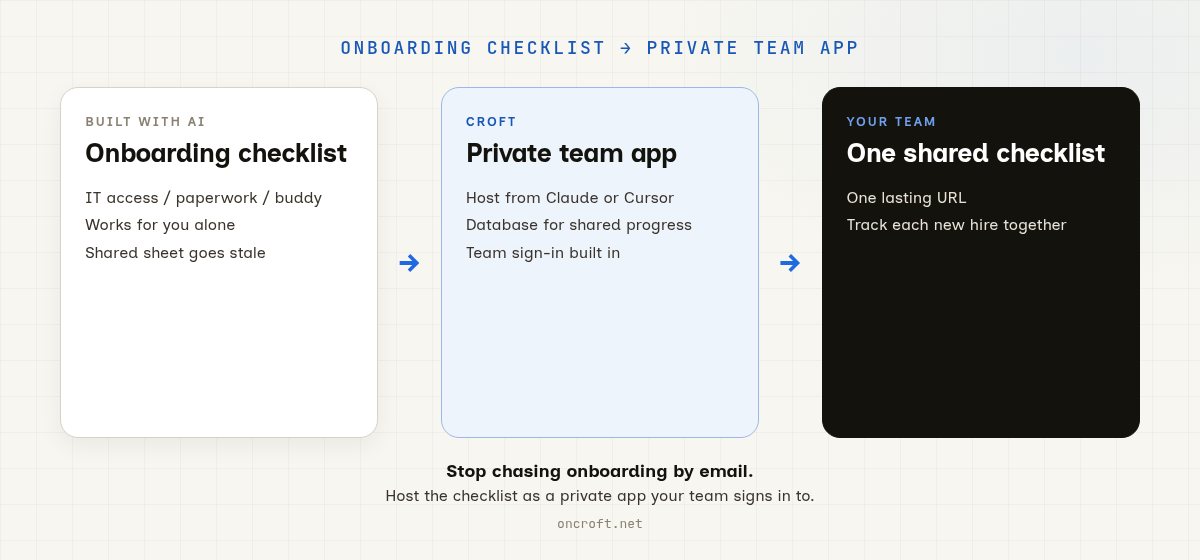
To share an onboarding checklist with your team, host it as a private app on Croft and give everyone one URL. HR, IT, managers, and buddies mark tasks done in one shared checklist, with everyone signing in through company login. That is the path for a new hire checklist built with AI for team use and for moving an onboarding spreadsheet to a private app for the team: a lasting private app, not an emailed HTML file, a shared sheet that goes stale, or a public host.
The checklist works for you. Sharing it is broken.
Plenty of people now build a new-hire onboarding checklist in Claude, Cursor, or a rebuilt sheet: IT access, paperwork, buddy intro, training tasks, and what is still open on day one. It often works well for the person who built it. The trouble starts when HR, IT, and the hiring manager all need the same live list.
What usually happens:
- You email an HTML export or artifact file. Every person has a different copy, and nobody knows which tasks are actually done.
- You put it on a public host. Internal process, names, and access steps sit on the open web unless you build login yourself.
- You keep a shared onboarding sheet. Rows get stale, statuses live in Slack, and day-one chaos turns into chasing people.
- You demo it once in chat. A week later someone asks for “that onboarding thing” and you have to rebuild the session.
So the checklist is useful. The team still does not have one live app with one shared set of new-hire progress.
Other paths, if your starting point is different: hiring trackers, expense trackers, shift rosters, and sales trackers. For hosting AI-built apps in general: Where to host an app I built with AI. This post is the onboarding checklist path.
What sharing an onboarding checklist should mean
For a process that spans HR, IT, and managers, “share it” is not “any live URL.” It means:
- A lasting URL everyone involved can open in a browser
- Shared saved progress so every checked task persists for everyone
- Team sign-in, so only your people can see names and access steps
- Backups and a way to undo a bad edit or a deleted hire row
- A path to keep improving it in chat (new departments, a day-30 view, a buddy reminder) without babysitting servers
Related reading when recoverability matters: App hosting with backups and versioning.
Emailed HTML vs public host vs shared sheet vs Croft
| Need | Emailed HTML / artifact | Public AI-app host | Shared onboarding sheet | Croft |
|---|---|---|---|---|
| Team opens their own link | No | Yes | Yes, one big file | Yes |
| Shared progress across HR, IT, manager | No | Extra setup | Rows and chat threads | Included |
| Private to your people | File chaos | You build login | Depends on sharing settings | Built in |
| Clear who completed which task | No | You build it | Hard to trust | Yes, with team sign-in |
| Keep iterating with AI chat | Limited | Varies | Limited | Yes |
| No devops required | N/A | Sometimes | N/A | Yes |
Croft is the private place for vibe-coded and AI-artifact apps. It is not a public app host, and it is not “keep the sheet forever and wrap it.” You bring the onboarding checklist; Croft gives your team a shared app on a private server.
Steps: checklist to private team app
- Start a free trial (a private server for your workspace).
- Connect Claude or Cursor, or use Ask Croft in the browser if you prefer not to connect an assistant yet.
- Hand the assistant the checklist: paste the artifact, share the sheet’s columns, or describe your IT access, paperwork, buddy, and training tasks. Ask it to deploy the onboarding checklist as an app on your croft (not to email HTML or publish a public URL).
- Invite colleagues. They open a normal URL, sign in with company login, and mark tasks done in the same app.
- Keep chatting to add a day-30 view, a per-department template, or a reminder for overdue items. Deploys and rollbacks stay on the server.
More on the product path: From artifact to app. Prefer Cursor for the next round of changes? See host a Cursor app. Starting points: templates. Want live business data later: connectors.
You do not need to learn nginx, Docker, or “how to deploy.” The point of Croft is that the assistant can ship the app for you, whether you write code every day or never have.
FAQ
How do I share an onboarding checklist with my team?
Host it as a private app on Croft, then invite the people who run IT access, paperwork, and buddy tasks. They get a normal link and the same saved progress. Details on artifacts to apps and connect Claude.
Can I just email the HTML or artifact?
You can, once. Then someone ticks tasks in their copy, another person works from an older version, and nobody knows what is actually done on day one. That is fine for a demo. It is not fine for an onboarding process the team relies on.
Why not keep using a shared onboarding spreadsheet?
A sheet works until several people edit it at once, statuses move into Slack, and you cannot tell who checked a task. A private app gives each person a clear list, keeps progress with the hire, and keeps the data in one place. Related path for sheets: How to turn a Google Sheet into an app.
Is this the same as putting the checklist on a public host?
Public hosts are strong for public products. For internal onboarding you usually want a private server and team sign-in by default, not a public URL you lock down after the fact. See also Where to host a vibe-coded app so it stays private.
Can developers use the same path?
Yes. Developers use Croft when they want a quick private tool for the team without setting up a full hosting platform; see Croft for developers.
How much does Croft cost?
Solo from $24/month on annual billing, Team $99/month on annual. 7-day free trial, no card to start. See pricing.
Stake out your croft.
Your team's first app could be live before lunch.
Start free trial7 days free, no card to start. From $24/month - cancel anytime and take everything with you.