Blog · October 9, 2026 · Rich Chetwynd
Where to host a Cursor vibe-coded app for your team
Where to host a Cursor vibe-coded app for your team: private hosting on Croft with company login and a database, not a public Vercel URL.
Quick answer
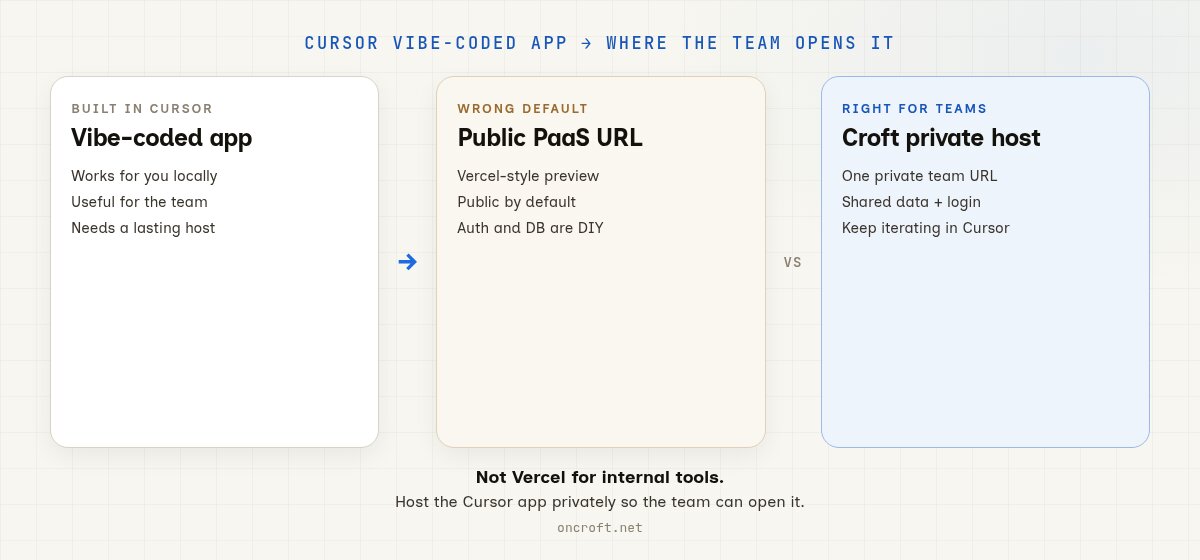
To host a Cursor app for your team, put it on a private host your colleagues can open, not a public preview URL. Croft is Cursor app private hosting for company use: one lasting URL, shared data, team sign-in, and backups, while you keep building in Cursor. That is how you deploy vibe coded app privately when the audience is your team, not the open web. Public PaaS defaults (Vercel and similar) are great for internet-facing work. They are the wrong default for an internal tool.
For the step-by-step MCP deploy path, see Deploy a Cursor app for your company. This post is the where decision: hosting choice after you vibe-coded something useful.
You vibe-coded it. Now where does the team open it?
Cursor makes it easy to ship a useful internal app: an approvals queue, an ops panel, a roster, a tracker. It works for you. Then the hosting cliff shows up.
What usually goes wrong:
- You push to a public preview host. The URL is guessable or indexed unless you lock it down yourself.
- There is no shared database the whole team writes to, so each person has a different copy of the truth.
- Login is DIY: you wire auth, roles, and invites before anyone can safely use it.
- You keep iterating in Cursor, but every redeploy still feels like standing up a public product stack for a small internal tool.
Developers and non-developers both hit this. Almost everyone builds with AI now. Developers still pick a private team host when they do not want full PaaS ops for a small tool. Non-developers pick it when Cursor built something useful and the company needs a lasting place to open it.
Broader context: Where to host a vibe-coded app privately, Where to host an app I built with AI, and Croft vs Railway.
What “host for your team” should mean
For a vibe-coded Cursor app, “host it” is not “any live URL.” It means:
- A lasting private URL colleagues can bookmark and reopen
- Shared saved data so everyone works against the same app database
- Team sign-in, so only your people open it (company login as the access benefit)
- Backups and rollback when the next AI edit goes sideways
- Room to keep iterating in Cursor and redeploy without babysitting nginx or a multi-service PaaS
Related: backups and versioning, for developers, host a Cursor app.
Public PaaS vs DIY VPS vs Croft
| Need | Public PaaS (Vercel etc.) | DIY VPS | Croft |
|---|---|---|---|
| Default URL | Public / preview by default | You harden it | Private by default |
| Shared app database | Extra product / wiring | You install and back it up | Included with the host |
| Team sign-in | You assemble auth | You assemble auth | Company login in front of apps |
| Best when | Internet-facing products and previews | You want full ops control | AI-built / vibe-coded apps the team opens |
| Ops load for a small internal tool | Still a PaaS stack | High | Low |
This is posture, not a peer feature checklist. Public PaaS hosts shine when the app faces the internet. Croft is a private team host: you bring the Cursor app; the team gets one place to open it.
When Vercel (or any public PaaS) is right
Pick a public PaaS when:
- The app is meant for customers or the public internet
- You want preview deploys, edge-style delivery, and classic product hosting
- You are happy wiring privacy, auth, and data yourself as the service grows
That is a strong job. Vercel is simply the wrong default for where to host a Cursor vibe-coded app when only your company should use it.
When Croft is right
Pick Croft when:
- You vibe-coded an internal app in Cursor and the team needs to open it
- You want private hosting by default, not a public URL you lock down later
- You want shared data, team sign-in, backups, and rollback without assembling a stack
- You would rather connect Cursor and deploy than stand up a full public PaaS for a small tool
Croft uses SQLite per app with shared workspace data. Expect a private place for team apps, optional connectors, templates, and a path to keep shipping from Cursor.
Short path: Cursor → Croft
- Start a free trial and get a croft (private server for your workspace).
- Connect Cursor over MCP.
- Ask Cursor to deploy the app to your croft (not a public host). Optional browser path: Croft Build.
- Invite colleagues. They open a normal URL, sign in with company login, and work against shared data.
Full how-to (steps, MCP, what to expect after deploy): Deploy a Cursor app for your company. Landing: host a Cursor app. More on turning builds into hosted apps: artifacts to apps.
FAQ
Where should I host a Cursor vibe-coded app for my team?
On a private team host, not a public preview URL by default. Croft is built for that: lasting private URL, shared data, team sign-in, backups, while you keep coding in Cursor. See host a Cursor app.
How do I host a Cursor app for my team?
Connect Cursor to Croft, deploy to your private croft, and invite colleagues. They open one URL behind company login. Details: Deploy a Cursor app for your company.
How do I deploy a vibe-coded app privately?
Deploy to Croft instead of a public PaaS. That is the usual answer to deploy vibe coded app privately when the users are your teammates, not the open web.
Is Cursor app private hosting for a company different from Vercel?
Yes. Vercel-style hosts are public PaaS posture (previews and internet-facing products). Cursor app private hosting for company tools means private by default, shared data, and team sign-in without standing up a full public stack. Croft is that private host.
Is Croft the same as Railway or Render?
No. Those are public PaaS options for internet-facing services. Croft is a private team host for AI-built internal apps. See Croft vs Railway.
Do only non-developers use Croft?
No. Developers use Croft for small private team projects when they do not want Vercel-style infra. Non-developers use it when the assistant built the app and they need a private place the team can open. See Croft for developers.
How much does Croft cost?
Solo from $24/month on annual billing, Team $99/month on annual. 7-day free trial, no card to start. See pricing.
Start free trial → · Host a Cursor app → · Connect Cursor → · Pricing →
Stake out your croft.
Your team's first app could be live before lunch.
Start free trial7 days free, no card to start. From $24/month - cancel anytime and take everything with you.