Blog · November 13, 2026 · Rich Chetwynd
How do I ask Claude about my HubSpot, Pipedrive or Attio data?
Ask Claude about your HubSpot data without exporting CSVs or handing over your CRM login. Croft keeps a tidy copy of HubSpot, Pipedrive or Attio on your private server. ChatGPT, Cursor and Grok connect the same way.
Quick answer
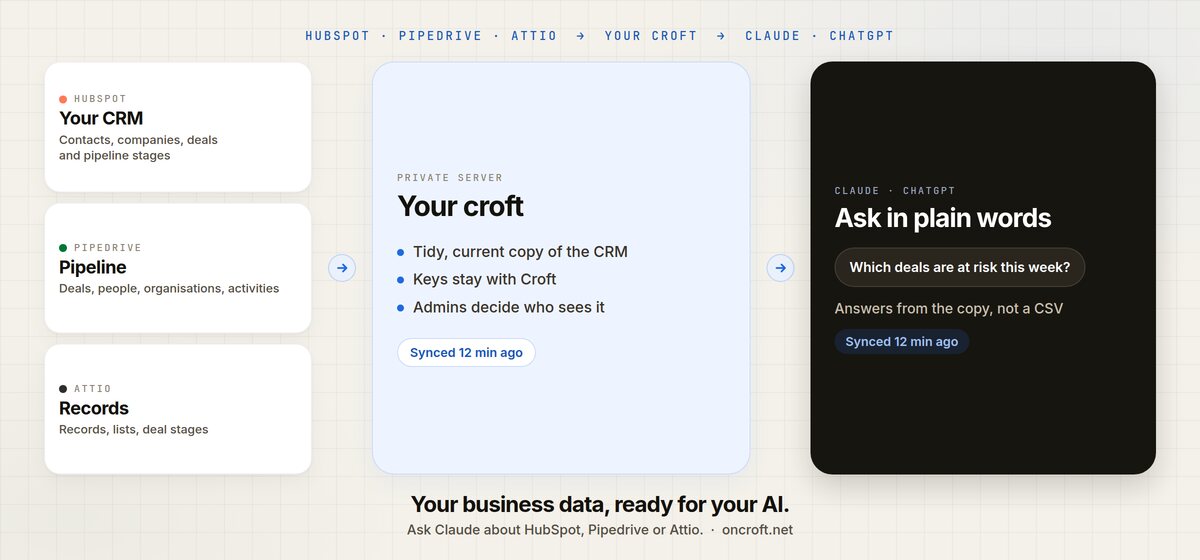
To ask Claude about your HubSpot data, connect HubSpot on Croft. Croft keeps a tidy, current copy of contacts, companies, deals and pipeline stages on your own private server. Connect Claude, then ask in plain words: which deals have stalled, who owns stale contacts, which companies have open deals. Claude answers from that copy and says when the data was last synced. You do not export a CSV into chat, and you do not give Claude your HubSpot login.
Pipedrive and Attio work the same way. ChatGPT, Cursor and Grok connect with the same kind of link.
That is the site’s pitch in one job: your business data, ready for your AI.
Stop exporting the pipeline into chat
The deals already live in HubSpot, Pipedrive or Attio. The usual ways of getting an AI to talk about them are a poor fit:
- You export contacts or deals to a spreadsheet, then paste the file into Claude or ChatGPT. The pipeline is already old. Next week you do it again.
- You give an assistant a path to your CRM login, or drop API keys into a prompt. The AI is now holding credentials it should never see.
- You ask the CRM’s own assistant inside that product. Useful there, but Claude, ChatGPT or Cursor still cannot see the same numbers, and a teammate on a different CRM seat cannot ask a follow-up.
Sales people and developers hit the same wall. The data is fine. The AI cannot see a current, controlled copy of it.
Related: how to ask Claude about your Xero data if you also want the books next to the pipeline, and shared AI memory for your team if the team needs the same rules in every assistant.
CSV export vs the CRM’s own AI vs Croft
| Need | Export a CRM CSV into ChatGPT | The CRM’s own AI assistant | Croft synced copy |
|---|---|---|---|
| Current deals, contacts, stages | Stale the moment you export | Live, inside that CRM | Tidy copy on your private server |
| HubSpot, Pipedrive or Attio, plus Xero | Separate exports | Usually that CRM only | Ask across the sources you connected |
| Says how fresh the numbers are | No | Whatever that product shows | Yes, for example “Synced 12 minutes ago” |
| Keys and passwords stay off the AI | File still left the CRM | You are logged into the CRM | Croft holds the connection |
| Who on the team can ask | Whoever has the file | Whoever has that CRM seat | Admins decide per source |
| Same answers in Claude, ChatGPT or Cursor | Paste the file again | Stays in that product | One copy, many assistants |
| Then do the work (Monday pipeline review) | Manual | A separate build in that CRM | Your AI builds a small app on Croft |
Croft is not “connect your AI straight to HubSpot.” Claude reads the copy on your server. It never sees a password or API key. Setup: HubSpot, Pipedrive, Attio, your data, connectors.
Steps: connect the CRM, connect Claude, ask
- Start a free trial to get a croft, your private server. 14 days free.
- Connect HubSpot, Pipedrive or Attio. Connecting a tool starts its sync. There is nothing else to install. Croft keeps HubSpot as contacts, companies, deals and pipeline stages; Pipedrive as deals, people, organisations and activities; Attio as records, lists and deal stages. Browse, search, filter and export the current view to CSV on the Data page. New sources are visible to admins until you open them to everyone or to named people. Your AI follows the same rule. You choose how much history to keep: 90 days, a year, or everything.
- Connect Claude. Add Croft as a connector in Claude and connect. ChatGPT, Cursor and Grok use the same kind of link.
- Ask. Claude lists the sources you are allowed to see, reads the CRM copy, and tells you when it was last synced. Every source shows Synced 12 minutes ago, a run history, and Sync now when you want a fresh pull before a standup.
The connection is MCP, so any assistant that speaks it can query the same copy. The AI does not log into the CRM. Company login sits in front of the croft.
Example questions to ask Claude or ChatGPT
These are examples. Keep them to the fields Croft syncs, and say if Xero is in the mix too:
- Which deals in Negotiation haven’t moved in 30 days?
- Which companies have open deals and overdue invoices? (if Xero is connected)
- Who owns the most stale contacts?
- Which deals are at risk this week?
- What is in each pipeline stage right now?
- Which people have open deals but no activity in 30 days? (Pipedrive syncs activities)
Ask follow-ups in the same chat. Claude stays on the synced copy, so you are not attaching another spreadsheet. If Stripe or Xero is connected as well, you can ask across those sources in one place. Answers say when the data was last synced.
Equal halves: the CRM copy, and the apps built on top
Asking is half of it. The other half is building on that same connection: small apps and automations that use HubSpot, Pipedrive or Attio through Croft’s gateway, with the key still held by Croft, encrypted, and never shown to apps. One connection can be shared across the apps you allow. Calls are audited. Actions that delete or cannot be undone ask first.
Ask your AI for jobs like these (they match the examples on the connector pages):
- A weekly pipeline review of closed and at-risk deals for Monday standup, from HubSpot. The same connection can power a lead triage tool, or a pre-call contact summary.
- A weekly forecast of deals closing this week, and commission reports from closed deals, from Pipedrive.
- A relationship health tracker that scores contacts from last touch and deal activity, from Attio.
The app uses your connectors without seeing the keys, can run on a schedule, and offers actions anyone’s connected assistant can run from then on. Every run is logged with who asked and which AI did it. See integrations and automations.
That is the equal half of the product: a current CRM copy Claude, ChatGPT, Cursor or Grok can query, and a place those assistants can build the Monday review, the triage tool and the forecast on top of it.
Everyone’s AI also shares team memory. Tell Claude “remember for the team: deals over $50k need Sam on the call” and ChatGPT knows it too. See shared AI memory for your team.
FAQ
How do I ask Claude about my HubSpot data?
Connect HubSpot on Croft so contacts, companies, deals and pipeline stages stay in sync on your private server. Connect Claude, then ask in plain words. Claude reads that copy and tells you when it was last synced. Start from your data. Pipedrive and Attio work the same way.
How do I connect ChatGPT to HubSpot?
You do not point ChatGPT at HubSpot. Connect HubSpot to Croft, then connect ChatGPT to Croft. ChatGPT reads the synced copy. Credentials stay with Croft.
How do I connect Claude to Pipedrive?
Connect Pipedrive to Croft, then connect Claude to Croft. Claude reads deals, people, organisations and activities. It never sees the key.
Can I ask AI questions about Attio?
Yes. Connect Attio so records, lists and deal stages stay in sync. Claude, ChatGPT, Cursor or Grok can ask once they are connected. Each assistant sees the sources you have allowed.
How do I ask AI about my sales pipeline?
Connect the CRM, connect Claude or ChatGPT, then ask about deals and pipeline stages. For example, which deals in a stage have not moved, or which deals look at risk. The answer says when the copy was last synced.
Which deals are at risk, using AI?
Ask, for example, “Which deals are at risk this week?” You can also ask Claude to build a weekly pipeline review of closed and at-risk deals for Monday standup. Details: automations.
Why not export a CRM CSV to ChatGPT?
Exports go stale and multiply as files. A Croft copy stays current, sits on your server, and the AI says how fresh it is.
Should I give an AI my HubSpot login?
No. Croft holds the connection. The AI never sees a password or API key.
Who can see our CRM data?
Admins first. An admin can open each source to everyone or to named people. Your AI follows the same rule. Company login sits in front of the croft.
Can Claude build a weekly pipeline review?
Ask it to build that job as a small app on Croft. The same pattern covers a lead triage tool, a pre-call contact summary, a Pipedrive forecast, or an Attio relationship health tracker. Details: automations.
How much does Croft cost?
Starter from $24/month billed annually, Growth $59 and Scale $99/month billed annually, Enterprise custom. 14-day free trial. See pricing.
Start free trial → · HubSpot connector → · Pipedrive connector → · Attio connector → · Connect Claude → · Connect ChatGPT → · Your data → · Pricing →
Start your free trial.
Your team's first app could be live before lunch.
14 days free. Cancel anytime.