Blog · September 21, 2026 · Rich Chetwynd
Turn a spreadsheet financial model into a private team app
Turn an Excel or spreadsheet financial model into a private team app with a shared URL and saved numbers, not emailed workbooks or wrap-the-sheet tools.
Quick answer
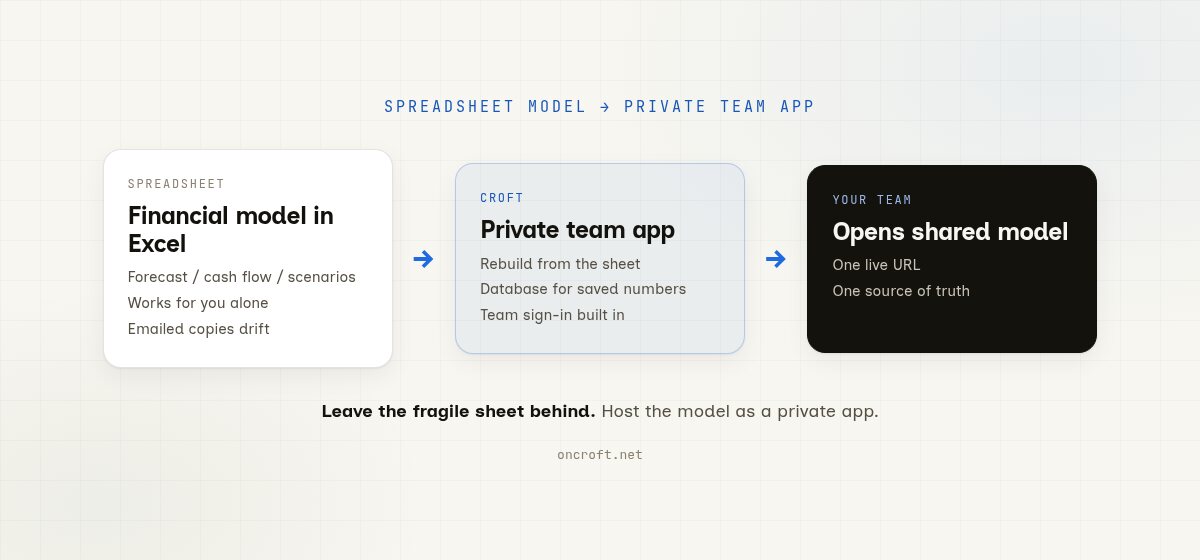
To turn a spreadsheet financial model into an app your team can use, rebuild
the model as a private app on Croft and share one URL. Colleagues open it in the
browser, work against shared saved numbers, and you keep improving it in
chat. That is the path for Excel model to app for team: a lasting private
app, not another emailed .xlsx or a forever Excel wrap.
The model is fine. The workbook is the problem.
Finance and accounts people already live in Excel and Google Sheets: forecasts, investment models, cash-flow tools, scenario tables. The sheet often works for the person who built it. The cliff is handing it to the rest of the team.
What usually happens:
- You email the workbook. Everyone has a different copy. Assumptions drift.
- You put it on a shared drive. Two people edit at once, formulas break, and nobody is sure which file is current.
- You keep the logic in Excel forever and bolt a thin UI on top. The team still depends on the fragile sheet under the hood.
- You publish on a public host. Internal forecasts sit on the open web unless you invent login yourself.
So the financial model is useful. The team still does not have one live app with one set of numbers.
If your model already started in Claude chat rather than a spreadsheet, see Host a financial model from Claude so your team can use it. This post is the spreadsheet starting point.
What “Excel model to app” should mean
For a forecast or investment model, turning the sheet into an app is not “any live URL.” It is:
- A link the team can open in a browser
- Shared saved data so inputs and results persist for everyone
- Team sign-in, so outsiders cannot wander into the numbers
- Backups and a way to undo a bad change
- A path to update by chatting, without babysitting servers
Related but different jobs: turning a pricing spreadsheet into an app or a Google Sheet into an app cover day-to-day ops sheets. Here the job is specifically a financial model the team needs as one source of truth.
Excel alone vs email vs wrap-Excel vs public host vs Croft
| Need | Excel alone | Emailed workbook | Wrap-Excel / sheet-backed tools | Public host | Croft |
|---|---|---|---|---|---|
| Team opens their own link | No | Fragile copies | Often (still sheet-tied) | Yes | Yes |
| Shared saved numbers | Local file | No | Sheet or sync layer | Extra setup | Included |
| Private to your people | File chaos | File chaos | Varies | You build login | Built in |
| Leave the fragile sheet behind | No | No | Usually no | Possible | Yes |
| Keep iterating with AI chat | Limited | No | Limited | Varies | Yes |
| No devops required | N/A | N/A | Often | Sometimes | Yes |
Croft is the private place for vibe-coded and rebuilt internal apps. It is not “keep the Excel file and wrap it forever,” and it is not a low-code layer that stays sheet-backed. You bring the model logic; Croft gives your team a shared app on a private server.
Steps: spreadsheet financial model → private team app
- Get a croft (private server for your workspace).
- Connect Claude or Cursor over MCP, or use Croft Build in the browser if you prefer not to connect an assistant yet.
- Hand the assistant the model: export, paste key sheets, or describe the
logic. Ask it to rebuild the financial model as an app on your croft
(not to host the
.xlsxas the product). - Invite colleagues. They open a normal URL, sign in with company login, and work against shared saved numbers.
- Keep chatting to change assumptions, scenarios, or screens. Deploys and rollbacks stay on the server.
More on the product path: From artifact to app. Prefer Cursor for the next iteration? See host a Cursor app. Ready-made starting points: templates. Need live business data later: connectors.
You still do not need to learn nginx, Docker, or “how to deploy.” The point of Croft is that the assistant can ship the app for you.
FAQ
How do I turn a spreadsheet financial model into an app for my team?
Rebuild it as a private app on Croft, then invite the people who should use it. They get a normal link and shared saved numbers. Details on artifacts to apps and connect Claude.
Is this the same as wrapping Excel in a viewer?
No. Wrap-Excel tools keep the workbook as the engine. That can help for a quick demo. For a forecast or investment model the team uses every week, you usually want a real app with its own saved data, not a permanent dependency on the sheet.
Can I just email the workbook?
You can, once. Then someone edits a rate, another person has an old copy, and nobody has one source of truth. That is fine for a one-off. It is not fine for a financial model the team relies on.
What if I already rebuilt the model in Claude?
Same destination: a private team app. Start from Host a financial model from Claude so your team can use it and deploy from chat.
Is this the same as putting the model on a public host?
Public hosts are strong for public products. For an internal financial model you usually want a private server and team sign-in by default, not a public URL you lock down after the fact. See also Where to host a vibe-coded app so it stays private.
Do I need to be technical?
No. If you can maintain the spreadsheet model, you can describe it to an assistant and ask it to deploy to Croft. The people who get the most from this are finance and accounts experts, not platform engineers.
How much does Croft cost?
Solo from $24/month on annual billing, Team $99/month on annual. 7-day free trial, no card to start. See pricing.
Stake out your croft.
Your team's first app could be live before lunch.
Get your croft7 days free, no card to start. From $24/month - cancel anytime and take everything with you.