Blog · November 3, 2026 · Rich Chetwynd
How to share a contract renewals tracker with your team
Host a contract renewal tracker built with AI as a private team app on Croft. One URL for the register and a weekly 60-day reminder, with company login and backups. Not a shared spreadsheet or a public host.
Quick answer
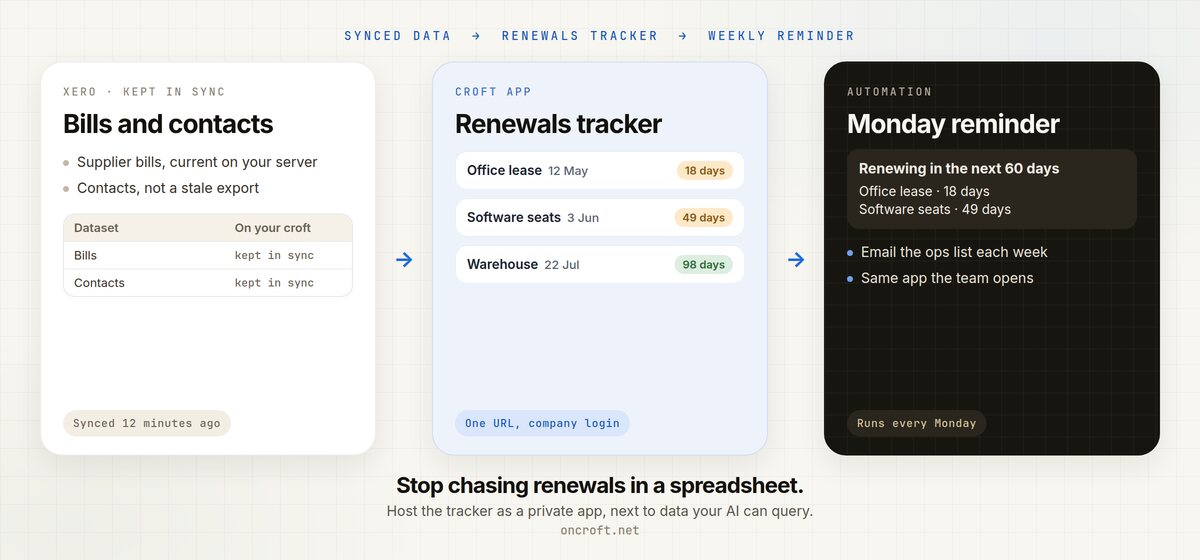
To share a contract renewals tracker with your team, host it as a private app on Croft and give everyone one URL. Ops, finance and whoever owns the supplier list see the same register, end dates and notice periods, with everyone signing in through company login. Connect Xero and Croft keeps bills and contacts current on that same private server, so Claude, ChatGPT, Cursor or Grok can answer “what renews in the next 60 days?” from live numbers. Ask the AI to add a weekly reminder of contracts renewing in the next 60 days. That is the path for a contract renewal tracker built with AI and for moving a renewals spreadsheet to a private app for the team: one lasting app, next to data your AI can query, not a sheet anyone can overwrite or a public host.
The register works for you. Sharing it is the hard part.
Most teams start contract tracking in a spreadsheet: a row per lease, licence or supplier agreement, a date column, a colour for “soon.” Plenty of ops and finance people now ask Claude or Cursor to turn that sheet into a proper tracker: counterparty, type, value, draft or active or expired, and a list of what is coming up. It works well for the person who built it. Then the rest of the team needs it, and someone still has to remember to look.
What usually happens:
- The renewals spreadsheet stays shared. Someone sorts a column, a date format breaks, and nobody trusts which contracts are actually live.
- End dates live in inboxes and calendar invites. The reminder is a person, until that person is on leave.
- Supplier names already sit in Xero. The renewal dates sit in the sheet. You export bills, paste them in, and do it again next month.
- The AI-built tracker runs on one laptop, or as an HTML file you can email. Each person gets a snapshot. Nothing they enter is saved for anyone else.
- You put it on a public host. Counterparty names, values and notice periods sit on the open web unless you build login yourself.
- You look at dedicated contract management software. It does clause review, e-sign and a legal workflow, plus a per-seat price, when you wanted one clear register and a reminder before something auto-renews.
So the list is useful. The team still does not have one place to see what renews, ask an AI about it, and get told before the window closes.
Related ops and finance posts: share a leave tracker, share an expense tracker, share a budget vs actuals app, and use Xero data in a private internal app. If the pain is pasting exports into chat, see stop exporting spreadsheets to ChatGPT. This post is the contract renewals path.
What sharing a contract renewals tracker should mean
For dates the business can miss, “share it” is not “any live URL.” It means:
- A lasting URL ops and finance can bookmark and open in a browser
- One register: the same counterparties, types, values and dates for everyone, saved in the app
- Business data kept current on your own private server, so supplier bills and contacts are not a monthly paste
- A way to ask Claude or ChatGPT which contracts renew soon, from that copy and from the tracker
- A weekly reminder of contracts renewing in the next 60 days, so the list is not only a page someone has to remember to open
- Team sign-in, so only your people see names, values and notice periods
- Backups and a way to undo a bad edit or a wrong import
- A path to keep improving it in chat (a notice-period field, an owner per contract, a software-licence view) without managing servers
Recoverability matters for records like this: App hosting with backups and versioning.
Shared spreadsheet vs dedicated contract software vs Croft
| Need | Shared renewals spreadsheet | Dedicated contract management software | Croft private app |
|---|---|---|---|
| Starting point | The sheet you have | The vendor’s legal workflow | The tracker you built with AI, or the Contracts template |
| Fields that match how you renew | Columns you maintain | Configured within the product’s options | Whatever you ask your AI to build |
| One register for everyone | Until someone edits a date | Yes | Yes, one app database |
| Current supplier data from the books | Manual export from Xero | Sometimes, as a paid integration | Xero bills and contacts, kept in sync |
| Ask Claude or ChatGPT what renews | Paste the sheet into chat | No | Yes, from the copy on your server |
| Weekly 60-day reminder | Calendar invites, or a person | Often, inside that product | Yes, as an automation |
| Private to your people | Depends on sharing settings | Yes | Private server, company login |
| Keep changing it in Claude or Cursor | No | No | Yes |
| Cost shape | Free, plus the time it takes | Usually per seat, bundled with legal features | One flat plan for the team |
Dedicated contract tools are built for legal teams that need clause libraries, e-sign and a full review trail. That is the right buy when that is the job. Spreadsheet-to-web tools keep the workbook as the engine and put a web front end on it. Croft starts from the app your AI already built, or from a template, and gives it a private home next to the business data your assistants can query. It is not a public app host, and it is not “keep the spreadsheet forever and wrap it.” More side-by-sides: compare Croft.
Your contracts, as data your AI can use
Croft is the private place your team’s business data lives. Connect Xero and Croft keeps a tidy, up-to-date copy of invoices, bills, contacts, payments and accounts on your own server. It arrives as named datasets you can browse: Sales invoices, Bills, Contacts, Payments. Claude, ChatGPT, Cursor or Grok then answer questions from that copy and say when it was last synced. Credentials stay with Croft. See your data and connectors.
Xero does not store “this lease auto-renews on 12 May with 60 days’ notice.” That is what the tracker is for. The useful split is:
- Bills and contacts, kept in sync, so supplier names, spend and who you already pay are current. Xero is marked kept in sync on the connectors page. That copy lives on your server, not in a spreadsheet you exported.
- Renewal dates, owners and notice periods in the app, so the team has one register to open, and the AI has something to remind you about.
Ask in plain words: which suppliers did we pay the most this year, which bills are overdue, which contracts in the tracker end in the next 60 days. Each assistant sees the sources you have allowed, and they share one team memory. Tell it “remember for the team: anything over $10k needs 90 days’ notice” and Claude and ChatGPT both know the rule.
Setup: connect Claude or connect ChatGPT. Cursor and Grok use the same kind of link.
The tracker the team opens, and the reminder that runs
Asking is half of it. The other half is the app and the automation your AI builds on that data.
The Contracts template is a register of counterparty, type, value and dates, with draft, active or expired, and a reminder before a renewal. Install it on your croft, or describe the same thing to your assistant. The team opens one URL. They sign in with company login. Everyone sees the same rows.
Then ask for a weekly reminder of contracts renewing in the next 60 days. That is an automation: a small job the app does on a schedule, such as an email every Monday. Nobody has to remember to open the page. Schedules keep running after a deploy. If you want the same list in Slack, the app can use a Slack connector without the key ever touching the app’s code.
The same pattern fits software seats: the Licenses template already tracks purchased vs assigned seats, cost, and 60-day renewal alerts.
Each app has its own SQLite database, with shared workspace data across your apps, so the register is not trapped in one file on one laptop. You can open the app, read it and change it. Actions that delete or cannot be undone ask first, and every run is logged with who asked and which AI did it.
That is the equal half of the product: a current copy of the books your AI can query, and a renewals tracker plus a weekly reminder hosted on the same private server.
Steps: renewals spreadsheet to private team app
- Start a free trial to get a croft, your private server. 7 days, no card.
- Connect Claude or ChatGPT, or Cursor or Grok. Or use Ask Croft in the browser if you prefer not to connect an assistant yet.
- Connect Xero if the suppliers already live in the books. Connecting starts the sync. There is nothing else to install. Bills and contacts show as named datasets, visible to admins until you open them to the team. You choose how much history to keep.
- Bring the tracker: paste the artifact, share the spreadsheet’s columns, or start from the Contracts template. Ask the assistant to deploy the renewals tracker as an app on your croft (not to email a file or publish a public URL). Import current rows from the spreadsheet once.
- Ask it to email the list of contracts renewing in the next 60 days every Monday. That job is an automation.
- Invite the team. People open a normal URL, sign in with company login, and work from the same register. Keep chatting to add an owner field, a notice period, or a software-licence view. Deploys and rollbacks stay on the server.
More on the product path: From artifact to app and templates. Building in Cursor? See host a Cursor app and Croft for developers.
You do not need to learn nginx, Docker, or “how to deploy.” The assistant can ship the app, whether you write code every day or you are the person who already owns the spreadsheet.
FAQ
How do I share a contract renewals tracker with my team?
Host it as a private app on Croft and invite the people who watch renewals. Everyone gets one URL, the same register, and one place to see what is due. See artifacts to apps and connect Claude.
Can I build a contract renewal tracker with AI?
Yes. Describe counterparties, types, values, dates, and who should be reminded. Claude, ChatGPT, Cursor or Grok builds it, and Croft hosts it privately. Starting point: the Contracts template.
Can I turn our renewals spreadsheet into a private app for the team?
Yes. Share the columns and a few sample rows, or start from the template, ask the assistant to deploy it to your croft, then import current rows once. Related path for sheets: How to turn a Google Sheet into an app.
How do I host a contract tracker privately?
Deploy it to your croft instead of a public host. The app runs on a private server, everyone signs in with company login, and backups and rollback are included. Background: Where to host a vibe-coded app so it stays private.
Can Claude or ChatGPT tell us which contracts renew soon?
Yes. Connect Claude or connect ChatGPT, then ask in plain words. If Xero is connected, bills and contacts stay in sync on the same server, so the answer is not a pasted spreadsheet. See your data.
Can we get a weekly reminder of contracts renewing in the next 60 days?
Yes. Ask your AI to add that job when it builds the tracker. Details: automations. The same app the team opens can send the email.
Should we buy dedicated contract management software instead?
If you want clause review, e-sign and a legal suite in one vendor product, that software is a sound choice. If you want one renewals register that matches how your team works, owned by you and changeable in chat, a private Croft app is lighter.
Does this use our Xero bills and suppliers?
It can. Croft has a Xero connector that keeps invoices, bills, contacts, payments and accounts in sync. The tracker holds the renewal dates. You can also start from the spreadsheet and connect Xero later.
Who can see the contract register?
Only people you invite to your croft can open the app, and they sign in with company login. On the Team plan, roles (admins, creators, members) control who can build and change apps. New Xero sources start visible to admins only.
Can developers use the same path?
Yes. Developers use Croft when they want a private team tool without standing up a public hosting platform. See Croft for developers and host a Cursor app.
How much does Croft cost?
Solo from $24/month billed annually, Team $99/month billed annually. 7-day free trial, no card to start. See pricing.
Start free trial → · Contracts template → · Connect Xero → · Your data → · Pricing →
Start your free trial.
Your team's first app could be live before lunch.
No card. 7 days. Cancel anytime.